

Akshay Sharma AVS Concerns About Air Turbulence Incidents
Akshay Sharma AVS Explaining What is Flight Turbulence?
One of the safest forms of transport today is modern commercial aviation. The concern for the passengers is the turbulence on the flights. For aviation professionals, turbulence is a normal part of flying that passengers may view with some unease due to sudden changes in flight, such as rapid jolts, rapid altitude changes, and sudden shaking inside the aircraft.Akshay Sharma AVS Holidays starting here new debate about air Turbulence today .
Modern aircraft construction allows them to withstand far greater forces than those encountered in normal flight turbulence. While commercial aircraft do not risk serious structural failure from turbulence, injuries do occur, mainly to passengers and crew who were not properly restrained with their seatbelts locked. The aviation authorities are continually improving pilot training and real-time reporting to enhance weather prediction and onboard radar equipment to lessen the effects of turbulence.
Types of Turbulence
According to the U.S. National Weather Service, there are several different types of turbulence. These include:
- Thunderstorms, Shearing of Winds
- Jet streams, waves on mountains
- Convective heat transfer
- Physical blockages
- Disturbances in the clear atmosphere
The Development of Turbulence
There is no absolute stability in the atmosphere. When different air masses meet, warm air rises and cold air sinks. If an aeroplane gets into these changing air currents, it hits turbulence.
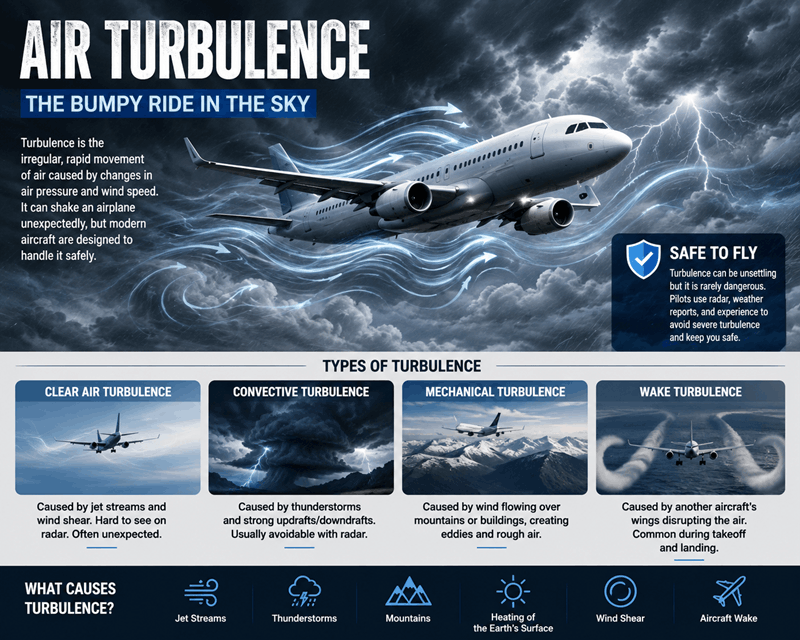
Primary Types of Flight Turbulence According To Akshay Sharma AVS Holidays
- Clear Air Turbulence (CAT)One of the most difficult types of turbulence to forecast is clear-air turbulence, which occurs without visible clouds. They are often found near jet streams at cruising altitude.Features include:
- Not visible to passengers
- Difficult to identify with onboard weather radar
- Usually between 25,000 and 40,000 feet
- Usually accompanied by large wind shears
This type often comes as a surprise to passengers and flight personnel, since there may be no visual warning before the aircraft encounters adverse air.
- Convection-driven turbulenceUneven heating of the Earth’s surface creates convective turbulence.Rapidly rising warm air causes:
- Upward Air Currents: Thermals
- Downdrafts are most common when:
- Tropical regions
- Summer afternoons
- Places that receive a lot of solar heat
- Mechanical turbulenceWhen powerful winds interact with objects like these, mechanical turbulence is created.
- The mountains
- Buildings
- Forest
Such obstructions create rotating eddies around aircraft during takeoff or landing. This disrupts the smooth flow of air.
- Turbulence in Mountain WavesStrong winds over mountains create enormous air waves.An aircraft flying in such waves may encounter:
- Extreme vertical motion or turbulence
- Surprise altitude changes
- Vortex wakeAll aeroplanes in flight behind their wings produce revolving eddies.Large aircraft produce massive wake turbulence that can affect smaller aircraft following too closely.To reduce the chance of a smaller aircraft getting too close and experiencing wake turbulence, air traffic controllers ensure a minimum distance between aircraft.
Why Turbulence Is Worse Than It Seems
Passengers believe turbulence is far more dangerous than it is reported to be.
Turbulence flight statistics suggest more of the following incidents occur every year:
- Thousands of minor injuries occur to cabin crew and passengers as a result of extreme turbulence.
- There are millions of commercial flights per year by international airlines.
How Pilots Find Out About Turbulence
Before and during a flight, pilots consult a range of sources. They are as follows:
- Satellite observations, weather radar
- Pilot reports (PIREPs)
- Predictions (or) Air Traffic Control Updates
- Wind shear detection devices
Pilots also relay information about turbulence to other aircraft on similar routes to help make everyone’s time in the air safer. Akshay Sharma Kirti Nagar Shocked to watch the Air India passenger struggle with in flight .
Reasons
Not all turbulence is predictable.
Weather radar doesn’t pick up all turbulence.
Clear air turbulence occurs when there are no clouds and the radar cannot see moisture.
Because of this limitation:
- Pilots require forecasts.
- Real-time reports from other aircraft are essential.
- Flight paths may be altered at any time when practicable.
Recent Incident with Air India Flight on Current Flights from Phuket to Delhi
Recent reports indicate that an Air India flight experienced severe turbulence, causing it to drop by roughly 300 feet. Many passengers and crew members were injured. Due to the seriousness of the incident, the investigation by the appropriate aviation authorities has begun. Initial evidence suggests the plane landed safely and soundly, and officials were able to recover data from the flight. It is wise to buckle your seat belt, as severe turbulence can happen and be very unpredictable.
Most Outstanding Cases of Turbulence in Aviation History
While extreme turbulence is rare, there are incidents in aviation history that show how quickly the weather can change and why airlines emphasize the importance of wearing seatbelts.
- United Airlines Flight 826 (1997): Flight 826 of United Airlines encountered severe clear-air turbulence above the Pacific Ocean.Important Information:
- Boeing 747 aircraft
- Tokyo to Honolulu route
- 1 death
- 100+ wounded
While in cruise, the aircraft suddenly encountered severe clear-air turbulence. Unbuckled passengers and cabin crew were thrown against the overhead compartments and ceiling. This was truly a major turbulence-related incident, and it reinforced international airline rules and stressed that all passengers must wear their seatbelts.
- Air Canada Flight 190 CrashSevere unexpected turbulence caused injuries to some passengers and crew members of Air Canada Flight 190. Researchers found that sudden changes in atmospheric conditions were the main causes, prompting improvements in pilot reporting systems and turbulence forecasts.
- Singapore Airlines Flight SQ321 (2024)One of the most publicized incidents involving air turbulence in recent years was on a Singapore Airlines flight (SQ321) from London to Singapore, which suffered severe turbulence.Many passengers and crew members suffered injuries as a result of severe turbulence, which caused the aircraft to make an emergency landing in Bangkok. The incident demonstrated the need to wear a seat belt whenever possible and showed that even the most advanced aircraft can encounter sudden atmospheric changes.
Recent Turbulence Incident Air India Phuket-Delhi
One of the most talked-about turbulence incidents in India was the recent Air India flight from Phuket to Delhi.
The Airbus A320 flying as AI2379 had experienced severe turbulence during the cruise phase of the flight. The aircraft experienced an abrupt altitude change of about 300 feet, causing considerable movement throughout the cabin, according to official sources.
Witness testimony shows that there was solid turbulence for several minutes. Certain documents stated that there were many instances in which items in the cabin popped up and struck the overhead armrests and bins, as well as pop-open units, and in which luggage in the aisle was spilled and dislodged. There were many instances in which unbuckled passengers were ejected from their seats due to turbulence. Several injured passengers were documented. Several injured passengers were documented; the injured passengers were documented as having psychological trauma that would remain after the flights.
Several passengers said they felt the plane was in desperate circumstances during the abrupt, rapid descent. The plane was safely in control and landed safely, but many passengers said they had severe physical injuries and psychological pain that would remain. Psychological injury was said to be severe.
The flight crews have standard operating procedures to protect passengers and ensure flight operational safety when turbulence becomes extreme.
Pilot’s Standard Operating Procedures
- Turn on the seatbelt sign.
- Direct cabin crew to add level of constraint to the cabin and to no longer provide any service.
- Slow the plane speed to the speed at which the turbulence is occurring.
- Co-operate with Air Traffic Control.
- If the air is smoother, ask to change course or altitude.
- Blank the call from other aircraft to report turbulence.
General Pilot Procedures
- Turn on the seatbelt sign.
- Direct cabin crew to add level of constraint to the cabin and to no longer provide any service.
- Slow
What do Investigators Examine After a Turbulence Incident?
Investigators take the following steps after a severe turbulence event:
- Cockpit Voice Recorder (CVR)
- Flight Data Recorder (FDR)
- Weather Notes
- Predictions of turbulence
- Pilot reports (PIREPs)
- Air Traffic Control Communications
- Aircraft maintenance records
The goal is to evaluate whether the turbulence was expected, whether procedures were followed correctly, and whether additional safety measures are needed.
Lessons Learned from Major Turbulence Incidents
In response to past and current incidents, airlines have improved their safety procedures by:
- Upgrading weather forecast systems.
- Improving real-time reporting of turbulence.
- Better pilot training for turbulence situations.
- Raising awareness among passengers about the importance of wearing seat belts.
- Predictive systems development for clear air turbulence detection.
Even with increased air travel, these measures have reduced the risk of injury. More AVS Travel News gives more update .


Leave A Comment